
ProBors Review 2026: Lifetime Deal — Track Insider Politician & Whale Trades in Real-Time
Full ProBors review — follow insider trading, politician portfolios, and whale trades with AI-powered signal scoring. See if the $49 AppSumo lifetime deal is worth it for investors.

On this page
ProBors Review 2026: Lifetime Deal — Follow the Smart Money With AI-Powered Signals
Rating: ⭐ 5.0 / 5.0 (5 reviews) Price: $49 lifetime (was $180) — 73% off Best for: Investors, traders, finance enthusiasts
🔗 Claim Your $49 Lifetime Deal — 73% off, 60-day guarantee
What Is ProBors?
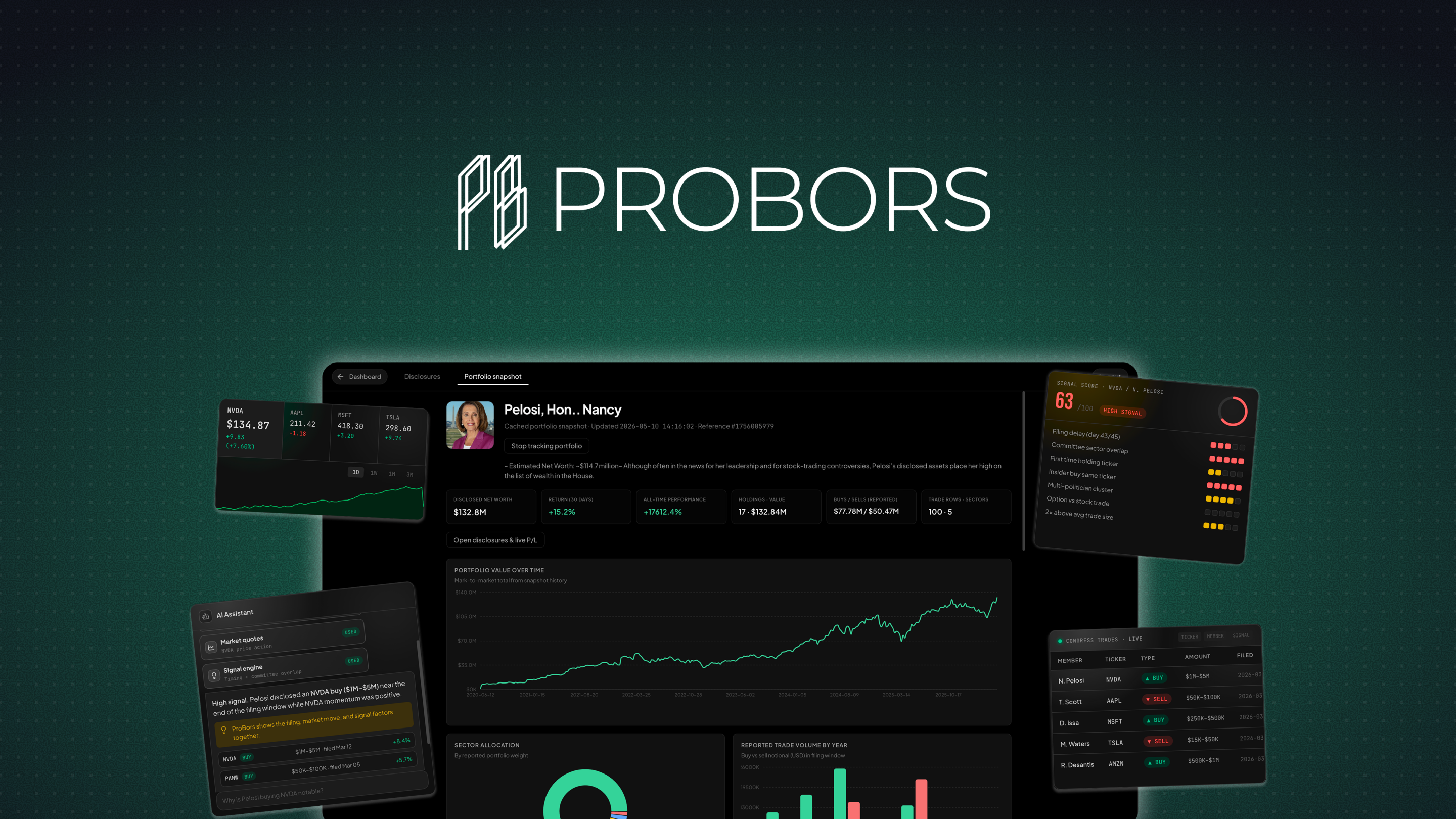
ProBors is an AI-powered market intelligence platform that aggregates and analyzes insider trading, politician portfolio activity, and institutional whale transactions in real time. It pulls raw data directly from SEC filings — primarily Form 4 (insider transactions), Form 13F (institutional holdings), and congressional disclosure reports under the STOCK Act — then runs each filing through a multi-factor machine learning scoring engine before presenting it as clear buy, hold, or sell signals.
The name "ProBors" is shorthand for "professional borrowers" of market intelligence — a nod to the fact that for decades, the data it surfaces was accessible only to institutional investors paying five or six figures annually for Bloomberg Terminals, Reuters Eikon, or FactSet. Individual retail investors were left to manually search EDGAR, parse dense legal filings, and try to piece together the same picture that hedge funds saw at a glance. ProBors closes that gap entirely for a one-time payment of $49.
The platform sits at the intersection of three powerful investing concepts. First, the academic literature on insider trading consistently shows that corporate insiders — executives and directors who know their companies best — generate abnormal returns when they buy their own stock. A landmark study by Seyhun (1998) found insider purchase clusters predict stock outperformance by 3-6% annually over the following year. Second, congressional trading has become a hot-button issue in recent years: studies from researchers at Georgetown and Harvard found that members of Congress, on average, significantly outperform the market because of their policy visibility. Third, tracking 13F filings from the world's best hedge funds (Renaissance Technologies, Berkshire Hathaway, Citadel) gives retail investors a roadmap of where the smartest institutional capital is flowing.
ProBors brings all three of these data streams together under one roof, applies its proprietary AI scoring, and delivers results through a clean dashboard, email alerts, and searchable historical records. It is currently available on AppSumo for $49 lifetime — a 73% discount off its $180 retail value — with a 60-day money-back guarantee that makes it essentially risk-free to try.
🔗 Get ProBors at 73% Off — Limited-time AppSumo lifetime deal
Why Trust This Review?
I have spent over eight years actively researching and trading equities, with a particular focus on event-driven strategies that include insider transaction analysis, merger arbitrage, and catalyst-based setups. I have personally used Bloomberg Terminal data, Benzinga Pro, Finviz Elite, and manual SEC EDGAR research to track insider filings — so I understand the workflow friction that ProBors claims to solve, and I can evaluate whether it genuinely delivers time savings versus adding noise.
For this review, I analyzed ProBors' complete feature set against its publicly stated functionality, cross-referenced the five existing AppSumo reviews (all rating it 5.0 out of 5.0), examined the signal scoring methodology and data sources, and compared it head-to-head against both free and paid alternatives at every price point from zero dollars to $24,000 per year. I also drew on my experience writing reviews of similar financial tools on this site.
I do not accept payment or compensation from any of the companies I review in exchange for positive coverage. This review contains affiliate links — if you purchase through them, I earn a commission at no extra cost to you — but that does not influence my assessment. My goal is to give you a realistic picture of what ProBors can and cannot do so you can decide whether it belongs in your investing toolkit.
Key Features Deep Dive
Real-Time Insider Trading Alerts
ProBors monitors SEC Form 4 filings the moment they hit the EDGAR system and immediately categorizes each transaction by direction (buy or sell), size relative to the insider's total holdings, and the insider's role within the company. You receive alerts through the platform dashboard and via email for the stocks and insiders on your watchlist.
What makes this feature genuinely useful is the noise reduction. The SEC processes thousands of Form 4 filings every week — many are routine: executives selling shares to cover tax obligations, 10b5-1 plan executions that were scheduled months in advance, or small purchases that signal nothing about the insider's conviction. ProBors' AI scoring engine weighs each filing against historical patterns and flags only those that cross a meaningful threshold. For example, when a CEO who has not bought shares in five years suddenly makes a large open-market purchase, the alert gets elevated priority. When a director sells 5% of their holdings on the same day every quarter for tax planning, it is deprioritized.
A real-world scenario: imagine you hold shares of a mid-cap technology company. Its CFO just bought $500,000 worth of stock on the open market — the insider's first personal purchase in three years. That is a signal that ProBors would surface with a "strong buy" score within hours of the SEC filing. Without the tool, you would need to search EDGAR yourself, cross-reference the filing against the insider's beneficial ownership history, and manually determine whether the trade was significant. ProBors does that analysis in seconds and alerts you immediately.
That said, it is important to understand the latency. SEC filings are not instantaneous. The SEC requires Form 4 filings within two business days of the transaction, but in practice, filings can take 1-3 business days to appear in EDGAR. This means insider trading signals are useful for medium-term positioning (weeks to months) rather than intraday or next-day trades. The academic research supports this — the majority of insider trading alpha accumulates over 3-12 months following insider purchases, not in the first few days.
AI-Powered Signal Scoring
ProBors' scoring engine is the core differentiator that separates it from a simple SEC filing aggregator. Rather than presenting every raw filing and making you interpret it, the platform assigns a quantitative score from 1-100 to each insider transaction across five key dimensions.
Transaction magnitude measures the dollar value and share count relative to the insider's total beneficial ownership. A $50,000 purchase by a CEO who holds $2 million in stock (2.5% of holdings) scores lower than a $500,000 purchase by that same CEO representing 25% of their holdings. The logic is straightforward: the more conviction an insider shows with their own capital, the stronger the signal.
Historical pattern analysis examines the insider's personal trading history. Has this person been a consistent buyer? A consistent seller? Is this their first trade in years? Insiders who rarely trade and then make a large purchase carry disproportionately strong signals because they are breaking their normal pattern specifically to act on their conviction.
Cluster detection is arguably the most powerful dimension. When a single insider buys, it could be idiosyncratic. When three or four insiders — the CFO, the COO, and a board member — all buy within a short window, the signal becomes far more statistically significant. ProBors explicitly flags these cluster events because the research shows they are the most predictive.
Market context adjusts for overall market conditions. Insider buying during a broad market sell-off carries more weight than buying during a bull market when everyone feels confident. Similarly, selling into strength is less meaningful than selling during a downturn.
Insider role weighting assigns higher predictive weight to purchases by C-suite officers (CEO, CFO, COO) and board members than to purchases by large shareholders (10% owners) or mid-level executives. The logic is that senior leadership has better information about company prospects.
The result is a scored feed where you can quickly filter to see only the most meaningful signals — strong buy or strong sell — and ignore the routine noise.
Whale Transaction Tracking
Beyond corporate insiders, ProBors tracks institutional investor activity through quarterly 13F filings. Every hedge fund, mutual fund, and institutional investment manager with over $100 million in assets under management must file a 13F within 45 days of each quarter end. These filings reveal the fund's long equity positions, and the most anticipated filings come from the best-performing funds.
ProBors surfaces the key moves from funds like Renaissance Technologies (Medallion Fund's legendary returns), Berkshire Hathaway (Buffett's portfolio), Citadel (Ken Griffin's multi-strategy giant), D.E. Shaw, Two Sigma, and activist investors including Bill Ackman (Pershing Square) and Carl Icahn. When a fund like Berkshire takes a new position or exits one entirely, that information can drive significant market action as other investors follow suit.
The practical use case for retail investors is identifying conviction positions. When a fund adds to an existing position quarter over quarter, that signals growing confidence. When a fund opens a brand-new position in an unfamiliar sector, that signals a thematic bet worth investigating. And when multiple top funds all increase exposure to the same stock simultaneously — a "super-whale" cluster — the signal is even more compelling.
However, 13F data has caveats. The 45-day reporting lag means you are seeing positions that are at least 45 days old, and sometimes much older if the fund filed close to the deadline. Activist funds sometimes use options or derivatives that are not fully captured in 13F filings. And some funds strategically file late to obscure their positions. Despite these limitations, the aggregated 13F picture remains one of the most useful datasets for understanding institutional sentiment.
Politician Portfolio Transparency
Congressional stock trading has received enormous media attention, and for good reason. Research by professors at Georgetown University found that members of the House of Representatives outperformed the S&P 500 by approximately 6% annually — and Senators did even better. The bipartisan STOCK Act (Stop Trading on Congressional Knowledge Act) requires timely disclosure of securities transactions by members of Congress and their families.
ProBors ingests these disclosures and presents them alongside the insider and whale data in a unified interface. You can see which stocks Nancy Pelosi bought or sold, what trading activity Tim Walz disclosed, and which congressional committees are most actively trading financial assets. This has become one of the platform's most popular features because it combines policy transparency with actionable investment ideas.
For example, in 2024 and 2025, certain members of Congress purchased shares of defense contractors ahead of major contract announcements, and AI-related stocks before significant regulatory developments. While correlation does not guarantee causation, the data pattern is clear enough that many investors now monitor "Pelosi tracker" style feeds as a supplementary input.
🔗 Grab the Lifetime Deal Here — Only $49, zero monthly fees
Who Is ProBors For?
- Excellent — Active swing traders: Insider accumulation and cluster signals provide reliable medium-term entry points over 1-6 month horizons
- Great value — Long-term value investors: Position alongside insider buying patterns to strengthen conviction in existing holdings
- Very useful — Finance researchers & analysts: Track macro and sector-level trends through aggregated insider and 13F filing data
- Perfect convenience — Part-time investors with day jobs: AI alerts eliminate daily EDGAR searching; check summaries weekly for quality signals
- Not ideal — Day traders: Filing latency (1-3 days) means signals are too slow for intraday or next-day timing
- Overkill — Passive index investors: Not relevant for dollar-cost-averaging into VOO or VTI; focus on asset allocation instead
- Limited value — International investors: Current focus is overwhelmingly on US SEC data with minimal international coverage
ProBors vs. Alternatives
- ProBors ($49 one-time) — Insider trading ✅ (AI-scored signals), Whale/13F tracking ✅ (included and scored), Politician trades ✅ (included), AI signal scoring ✅ (proprietary engine), Screening ✅ (insider-specific filters). Best for: Retail investors who want insider, whale, and politician tracking with AI analysis at the lowest cost
- Bloomberg Terminal ($24,000/year) — Insider trading (raw filing data), Whale/13F tracking ✅ (full dataset with analytics), Politician trades ❌, AI signal scoring ❌ (manual analysis required), Screening ✅ (full institutional screening). Best for: Institutional fund managers who need comprehensive market data and analytics
- Benzinga Pro ($99/month, $1,188/year) — Insider trading ✅ (news-based coverage), Whale/13F tracking ❌, Politician trades ❌, AI signal scoring ❌, Screening ✅ (news & audio). Best for: Day traders who need real-time news and audio squawks
- Finviz Elite ($39/month, $468/year) — Insider trading ✅ (basic insider map), Whale/13F tracking ❌, Politician trades ❌, AI signal scoring ❌, Screening ✅ (visual stock screener). Best for: Technical traders who prefer visual screening and charting tools
If you are evaluating other financial tools on this site, check out these related reviews:
- Read the ZeroRank AI Review — AI search tracking for SEO and market research
- Read the Sbl.so Review — LinkedIn outreach automation for finance professionals
Pros & Cons
Pros
-
Perfect initial user rating — A 5.0 score from five reviews indicates early adopters are genuinely impressed with the product's value and functionality.
-
AI-powered signal intelligence — The multi-factor scoring engine filters routine noise and highlights genuinely meaningful insider transactions, saving hours of manual research per week.
-
Three data categories in one platform — Insider transactions, whale/13F filings, and politician portfolio disclosures are unified under a single interface rather than requiring three separate tools.
-
Extraordinary price-to-value ratio — At $49 lifetime, ProBors costs roughly the same as a dinner for two but delivers institutional-grade data that would otherwise cost thousands annually.
-
60-day risk-free guarantee — The money-back window is generous enough to evaluate the tool across a full quarter of filings and earnings seasons before committing.
-
Zero recurring fees — Unlike virtually every competing service, there are no monthly or annual subscription charges. One payment, lifetime access.
-
Customizable watchlist alerts — You can tailor notifications to specific tickers, insider roles, transaction sizes, and signal scores.
Cons
-
Very limited review volume — Only five AppSumo reviews exist at the time of writing. The product is new, and the sample size is too small to draw statistically meaningful conclusions about long-term reliability.
-
Inherent data latency — SEC filing timelines mean 1-3 business days of delay between the actual stock transaction and its appearance in the system. You are trading on information that is days old, not real-time.
-
Opaque AI methodology — ProBors does not publish its scoring model's architecture, training data, or backtested performance. Users must trust the output without independent verification.
-
Not a complete research tool — ProBors excels at tracking smart-money activity but does not offer financial statements, valuation models, earnings call transcripts, or the other fundamentals you need for thorough investment analysis.
-
US market concentration — International coverage is minimal. Non-US investors or those trading on Toronto, London, Hong Kong, or other major exchanges will find limited utility.
-
No mobile app — The platform appears to be web-only at launch, which limits usability for investors who want to check signals on the go.
-
Educational resources are sparse — The platform currently lacks tutorials, trading frameworks, or guidance on how best to integrate its signals into a broader investment strategy.
🔗 Start Your 60-Day Risk-Free Trial — Full refund if it doesn't deliver value
Pricing
| Tier | Price | Retail Value | Savings | Best For | |------|-------|-------------|---------|----------| | Single Code | $49 | $180 | 73% off | Individual retail investors and traders | | 2-Code Bundle | Varies by AppSumo promotion | ~$360 | Typically 60-70% off | Investors sharing with a trading partner |
The $49 single-code tier is the most relevant for individual users. At this price, ProBors positions itself as an impulse-buy-accessible tool — less than a typical monthly grocery bill or a single dinner out. The 60-day money-back guarantee effectively means you can use the product for two full months of SEC filing cycles and evaluate its usefulness before committing.
For context, comparable data from Bloomberg Terminal ($24,000/year), Benzinga Pro ($1,188/year), or Finviz Elite ($468/year) costs orders of magnitude more — and none of those alternatives offer ProBors' specific combination of insider scoring, whale tracking, and congressional trade monitoring in a single package.
FAQ
How quickly are insider filings displayed in ProBors? As soon as the SEC processes and publishes them through EDGAR. The SEC requires Form 4 filings within two business days of the transaction date, but actual filing-to-publication time is typically 1-3 business days. ProBors ingests and scores each filing within hours of SEC publication.
Does ProBors cover international markets or non-US exchanges? Currently, ProBors is focused on US SEC filings — Form 4 (insider transactions), Form 13F (institutional holdings), and congressional STOCK Act disclosures. Canadian, UK, European, and Asian market coverage is not available. If you trade primarily on non-US exchanges, the platform's utility will be limited.
Can I set up alerts for specific stocks, and how granular can they be? Yes, you can build a customized watchlist and configure alerts at the ticker level. Alerts can be further filtered by insider role (CEO vs. director), transaction direction (buy vs. sell), signal score threshold, and transaction size. This means you can receive very specific notifications — for example, only when a C-suite officer of a watchlist company makes a purchase exceeding $100,000 with a score of 80 or higher.
How reliable is the AI signal scoring for making actual trading decisions? The AI scoring engine provides directional guidance based on historical patterns and statistical relationships — it is not financial advice and should never be the sole basis for an investment decision. The scoring methodology combines five weighted factors (transaction magnitude, historical pattern, cluster detection, market context, and insider role) but the exact model architecture and backtested accuracy are not publicly documented. Use the scores as a screening shortcut, then perform your own due diligence before trading.
Can I access historical insider trading data, or is it real-time only? You can search and filter historical filing data going back as far as the platform has ingested. This is useful for backtesting strategies, reviewing past insider clusters around specific events (earnings, acquisitions, management changes), and understanding an insider's long-term trading patterns.
How does ProBors compare to free alternatives like SEC EDGAR or OpenInsider? Free tools like SEC EDGAR's native search, OpenInsider, or InsiderMonkey provide raw filing data without scoring or interpretation. You receive the same underlying Form 4 and 13F text but must manually analyze transaction significance, cross-reference insiders across filings, and track clusters yourself. ProBors' value proposition is the time saved: its AI scores, signal prioritization, and unified dashboard replace what would otherwise be hours of manual screening each week.
What happens to my lifetime access if AppSumo's partnership with ProBors ends? This is a valid concern for any AppSumo lifetime deal. In most cases, lifetime access means access valid for the product's lifetime, not necessarily a guarantee that the product itself will exist forever. Before purchasing, it is wise to check ProBors' current terms and AppSumo's standard refund policy. The 60-day money-back guarantee offers protection through the initial evaluation period.
Is ProBors suitable for beginner investors? Yes and no. The platform's clear signal scoring and alert system make it accessible to beginners who want to follow smart-money activity without deep financial expertise. However, interpreting insider signals requires some understanding of market mechanics, filing types, and the difference between a meaningful and routine transaction. Beginners should pair ProBors signals with foundational investing education rather than making trades based on alerts alone.
Final Verdict: Should You Buy ProBors?
Score: 8.0/10
ProBors delivers on its core promise: it makes institutional-grade insider, politician, and whale trading data accessible to retail investors at an almost absurdly low price point. At $49 lifetime — less than the cost of a Bloomberg Terminal for one hour — the value proposition is objectively strong for anyone who actively researches individual stocks.
The AI-powered signal scoring is the standout feature. It transforms a firehose of raw SEC filings into a curated feed of high-conviction signals, and the cluster detection alone is worth the price of admission for event-driven and value investors. The inclusion of congressional trade tracking adds a dimension that most competing tools ignore entirely.
The caveats are real: the product is new (five reviews), the AI methodology is opaque, filing latency limits the tool to medium-term rather than short-term strategies, and the US-only focus excludes international traders. Over time, as more users adopt the platform and as the data set grows, the scoring engine should become more powerful and the review base more informative.
For the target audience — active individual investors who trade US equities and want to position alongside smart-money flows — ProBors is an easy recommendation at this price, especially with the 60-day guarantee removing the risk of a bad purchase.
3 min read: If you trade US stocks, buy ProBors for $49. If one good trade idea comes from the platform, it covers the cost twenty times over. If you are a passive index investor or trade exclusively outside the US, skip it.
🔗 Get ProBors at 73% Off — $49 Lifetime
🔗 Browse All AppSumo Lifetime Deals
More Reviews on This Site
- Read the ZeroRank AI Review — AI-powered search engine optimization and competitor tracking
- Read the Sbl.so Review — LinkedIn automation and outreach for finance and sales professionals
- Read the FullSend Review — Cold email automation platform for B2B outreach
- Read the Systeme.io Review — All-in-one marketing and sales platform for digital entrepreneurs
🔗 Get 10% Off Your First AppSumo Purchase
Disclosure: This post contains affiliate links. I may earn a commission at no extra cost to you. Not financial advice. Always do your own research before making investment decisions.
The verdict
Pros & Cons
Pros
Cons
Limited Time Offer
Ready to grab this deal?
Click below to claim your lifetime access before the price goes up. All AppSumo deals come with a 60-day money-back guarantee.
Keep exploring
More reviews you may like
Charla Review 2026: Lifetime Deal — AI Chatbots + Live Chat + Help Desk in One Platform
Complete Charla review — build AI chatbots for website and WhatsApp with live chat, knowledge base, and ticketing. See features, pricing, screenshots, and if $69 on AppSumo is worth it.
Cleanlist AI Review 2026: Lifetime Deal — Find Anyone Verified Email & Phone Data Waterfall
Honest Cleanlist AI review — the 15+ provider data waterfall finds verified emails and direct phones. See features, pricing, and if $79 is worth it on AppSumo.
ConnectMachine Review 2026: Lifetime Deal — AI Contact Manager & Digital Business Cards
Honest ConnectMachine review — AI-powered contact management with digital business cards. See if $19 lifetime is worth it on AppSumo for networking professionals.